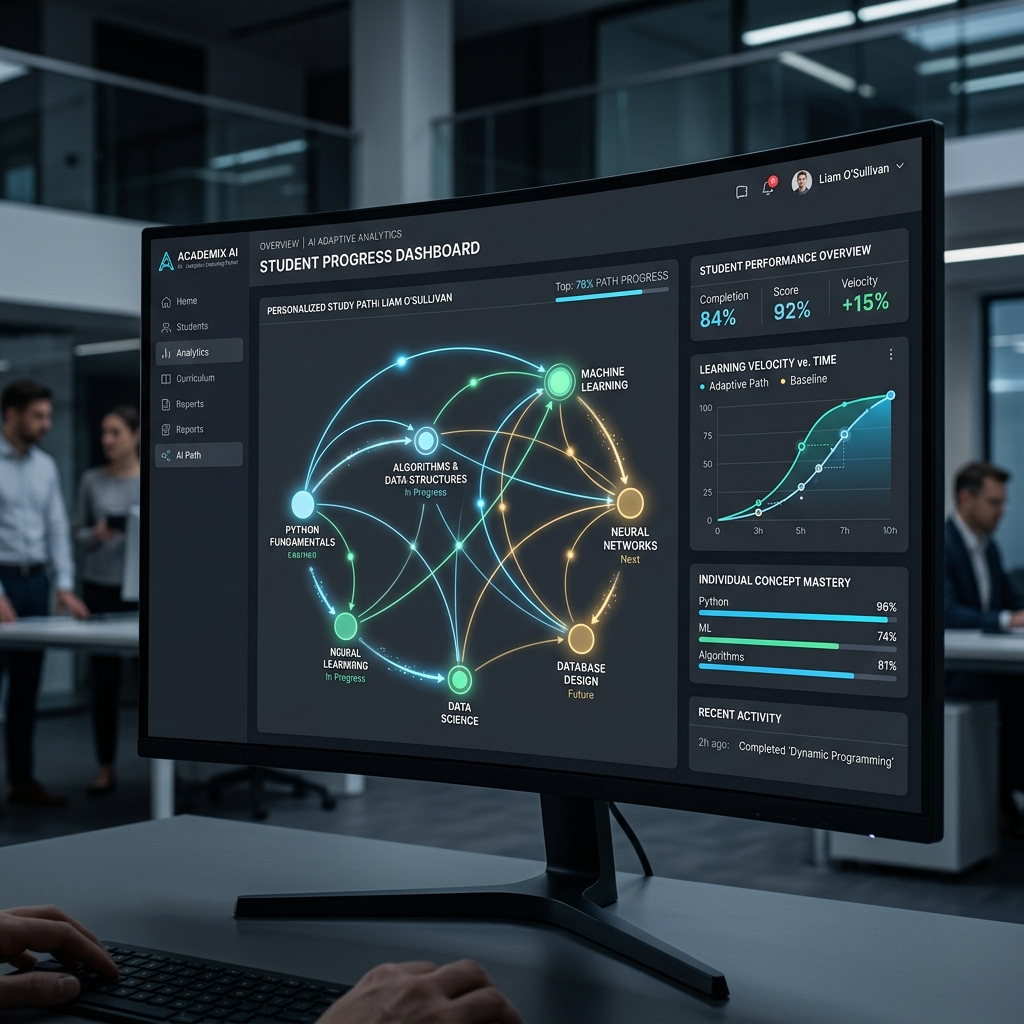
How Coaching Institutes Can Use AI-Powered Adaptive Learning to Personalize Exam Prep
Are you running a coaching institute, school, or skill academy using a one-size-fits-all approach to exam preparation? If your educators are delivering the exact same study plan to every student, you might be missing out on the biggest revolution in education technology: adaptive learning powered by artificial intelligence.
For institute owners and corporate L&D heads, ensuring that every learner achieves their maximum potential is the ultimate goal. However, manually tracking individual strengths and weaknesses across hundreds of students preparing for highly competitive exams like JEE, NEET, or UPSC is nearly impossible. This is where AI-driven personalized learning becomes your institute's greatest asset.
What is Adaptive Learning for Coaching Institutes?
Adaptive learning is an advanced educational technology that uses AI algorithms to analyze a learner's performance in real-time and dynamically adjust their learning path. Instead of forcing all students through an identical curriculum—a limitation often seen in basic platforms like Google Classroom—an adaptive system evolves based on:
- Questions students answer correctly or incorrectly
- Topics where specific learners spend more time
- Individual learning paces and retention patterns
- Historical performance trends over time
By integrating this technology, your institute can offer a highly personalized, premium learning experience without requiring your teachers to manually curate content for every single student.
How AI Identifies Weak Areas at Scale
Modern, specialized learning platforms like acadmi use sophisticated algorithms to pinpoint exactly where each of your students needs improvement. Here is how the methodology works:
1. Granular Question-Level Analysis
Every time a student attempts a practice question or mock test on your platform, the AI tracks multiple data points:
- Response accuracy: Did they answer correctly?
- Time taken: Are they spending too much time on certain question types compared to their peers?
- Attempt history: Do they consistently struggle with specific question formats?
2. Deep Topic and Subtopic Mapping
A robust system maps each question to specific syllabus topics. For example, in JEE Physics:
- Mechanics → Newton's Laws → Problems with friction
- Electromagnetism → Capacitors → Series and parallel circuits
This granular tracking helps your educators identify the exact subtopics where a student or an entire batch is lagging, allowing for highly targeted remedial classes.
3. Smart Difficulty Progression
The AI monitors performance across difficulty levels (Easy, Medium, Hard). If a student is consistently getting medium-level questions wrong, the adaptive engine knows not to push them to hard questions yet, preventing frustration and building confidence incrementally.
4. Learning Curve Analytics
The platform tracks the improvement rate over time. Your educators get dashboards showing exactly who is ready for advanced mock tests and who needs fundamental concept revision.
Creating Personalized Study Plans at Scale
Based on the AI analysis, the system automatically generates dynamic study plans tailored to individual learners. This level of automation is a game-changer for skill academies and test prep centers:
- Targeted Daily Recommendations: A student weak in organic chemistry receives automated practice sets focusing on reaction mechanisms, while a student struggling with calculus gets targeted math drills.
- Smart Content Sequencing: The AI arranges your institute's content in the optimal order for each learner—starting with gap-filling and moving to advanced practice.
- Automated Spaced Repetition: The system schedules revision cycles for concepts a student tends to forget, ensuring long-term retention.
The Business Advantage: Why Go Digital with Adaptive AI?
For decision-makers and institute owners, adopting an AI-powered LMS isn't just about better pedagogy; it is a strategic business advantage:
- Better Results and Ranks: Personalized learning directly translates to higher scores. Better student ranks mean better word-of-mouth marketing for your institute.
- Operational Efficiency: Your teachers save hundreds of hours that would otherwise be spent manually evaluating test papers and creating individual improvement plans.
- Premium Brand Positioning: Offering "AI-Powered Personalized Learning" allows you to position your institute as a modern, premium brand, giving you a competitive edge over traditional centers.
The Platform Choice: acadmi vs. The Alternatives
When taking your coaching classes online, selecting the right technology partner is critical.
Generic platforms like Google Classroom are excellent for basic file sharing and announcements but completely lack the assessment engines and AI analytics required for competitive exam prep.
On the other hand, traditional institute management softwares like Classplus or Classpro focus heavily on administrative tasks (fee collection, attendance) and basic video hosting. Their assessment tools are often rigid and lack deep adaptive learning capabilities.
acadmi is built differently. It is engineered specifically for the complexities of modern digital learning and exam preparation. With acadmi, you get:
- A dedicated, white-labeled platform that highlights your brand.
- Advanced, template-based assessment engines that replicate the exact interfaces of JEE, NEET, and CAT.
- Deep, AI-driven analytics that automatically adapt to your students' learning curves.
- A seamless, premium UX that rivals top-tier global edtech platforms.
By choosing acadmi, you aren't just getting an administrative tool; you are upgrading to an intelligent learning ecosystem designed to multiply your institute's success.
Frequently Asked Questions (FAQs)
What is the difference between adaptive learning and regular online tests?
Regular online tests serve the same questions to all students and provide a static score. Adaptive learning uses AI to analyze responses in real-time, dynamically adjusting the difficulty of subsequent questions and generating personalized revision paths based on performance.
Can adaptive learning software replace my teachers?
No. Adaptive AI is a tool designed to empower your educators, not replace them. It handles the heavy lifting of data analysis and basic personalization, allowing your teachers to focus on high-value mentoring, complex problem-solving, and motivational support.
Is it difficult to transition my traditional coaching institute to an AI-powered platform?
Not with the right partner. Platforms like acadmi provide end-to-end onboarding, helping you migrate your existing content, question banks, and student data seamlessly into the digital ecosystem.
How does adaptive learning improve student retention in my courses?
By preventing students from feeling either bored (if content is too easy) or overwhelmed (if content is too hard), adaptive learning keeps learners consistently engaged in their optimal "zone of proximal development," significantly reducing dropout rates.